86-0573-88960598 / Sales & Service Support
Email:fuluo@jxfuluo.com
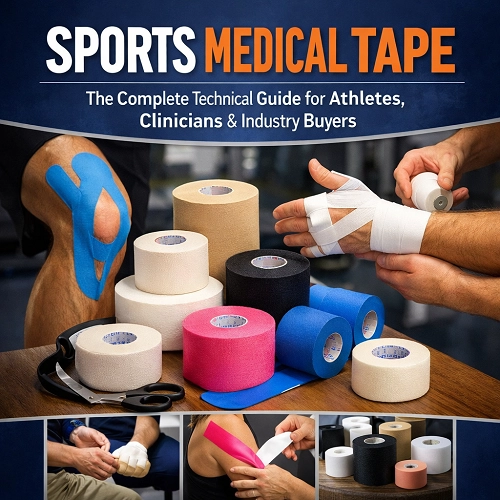
Sports medical tape is a broad category of pressure-sensitive adhesive products engineered specifically for musculoskeletal support, injury prevention, proprioceptive enhancement, and wound management in athletic and clinical settings. Unlike standard household tape, sports medical tape must balance a complex set of competing requirements: skin-friendliness, breathability, mechanical support, sweat resistance, and safe removability.
The global sports medicine market is expanding rapidly, driven by increasing participation in recreational and professional sports, growing awareness of injury prevention, and rising demand for non-pharmacological pain management. Sports medical tape sits at the intersection of materials engineering, biomechanics, and clinical science — making it one of the most technically nuanced product categories in healthcare.
Cross-sectional layer structure common to most sports medical tape products, from release liner to skin contact surface.
Key insight: The performance of any sports medical tape is determined not by a single layer but by the synergy between substrate elasticity, adhesive chemistry, and application technique. Understanding all three is essential for clinicians and procurement specialists alike.
The sports medical tape landscape can be broadly divided into five functional categories, each with distinct mechanical properties and clinical indications.
Elastic, skin-like tape designed to support muscles without restricting range of motion. The gold standard for soft-tissue rehabilitation.
Non-elastic zinc-oxide–based tape providing maximum joint stabilization. Standard for ankle and wrist strapping.
Cohesive or self-adhesive elastic wrap offering compression and moderate support. Widely used in team sports and emergency taping.
Traditional breathable tape for securing dressings, IV lines, and tube fixation. Available in non-woven, silk, foam, and transparent variants.
Foam-backed tapes with waterproof barriers. Used in aquatic sports, wound dressing under wet conditions, and post-surgical protection.
Foam-based protective layer applied beneath rigid tape to protect skin from friction, shear forces, and adhesive irritation.
| Type | Elasticity | Primary Use | Typical Material | Wear Duration |
|---|---|---|---|---|
| Kinesiology Tape | ~130–180% elongation | Muscle facilitation, edema, pain relief | Cotton + acrylic adhesive | 3–5 days |
| Rigid Athletic Tape | Non-elastic | Joint stabilization | Cotton + zinc oxide adhesive | 1 game / session |
| EAB | Moderate (50–80%) | Compression wrapping | Rayon/polyester blend | Hours to 1 day |
| Medical Plaster | Low to moderate | Dressing fixation | Non-woven / PE / silk | 24–48 hrs |
| Foam Tape | Moderate | Wound dressing, waterproofing | Polyurethane foam + acrylic | 2–7 days |
The substrate — the fabric or film backing of a tape — is its structural foundation. Material selection directly controls elongation, tear strength, moisture vapor transmission rate (MVTR), and patient comfort.
The most traditional substrate, used in both kinesiology and rigid athletic tapes. High-grade combed cotton offers excellent skin breathability with MVTR values typically between 800–1,200 g/m²/24h. The interlocked weave structure of kinesiology tape substrates is engineered with a diagonal bias cut so the tape stretches along its length but resists width deformation — mimicking the directional properties of fascia and muscle tissue.
Non-woven substrates (spunbonded or thermally bonded polypropylene or polyester) are the basis for most medical plaster tapes and wound dressing fixation products. They offer consistent porosity, low thickness, and gentle skin adhesion. Hypoallergenic grades use fibers treated to remove trace allergens, making them suitable for sensitive-skin applications and long-duration hospital use.
Transparent PU films provide a waterproof yet moisture-vapor-permeable barrier. They are critical in foam wound dressings and post-operative scar management products. High-quality PU films achieve MVTR values above 3,000 g/m²/24h while maintaining complete liquid impermeability, enabling use in showering or aquatic environments.
Some premium sports tape products incorporate neoprene or nylon-elastic blends to achieve higher elastic return forces and greater durability under sustained mechanical load. These are used where repeated cycling of stretch-and-recovery is required, such as in compression garment integration or orthotic tape systems.
Comparative performance radar chart for three primary substrate materials used in sports medical tape. Values are relative and illustrative of general industry benchmarks.
Kinesiology tape (KT) has been one of the most studied and debated products in sports medicine over the past two decades. Originally developed by Dr. Kenzo Kase in Japan during the 1970s, kinesiology taping methodology is today used by physiotherapists, athletic trainers, and sports physicians worldwide.
When kinesiology tape is applied with appropriate tension to skin over a muscle, the elastic recoil of the tape exerts a lifting force on the dermis. This decompresses the subcutaneous space, theoretically improving lymphatic and circulatory flow, reducing local pressure on nociceptors (pain receptors), and altering mechanoreceptor input — the latter being the proposed mechanism for its analgesic and proprioceptive effects.
Medical-grade kinesiology tape is precisely engineered to stretch to approximately 130–180% of its resting length — comparable to the elastic range of healthy human skin and fascia. This is achieved through the diagonal weave angle of the cotton substrate. A tape that stretches too little will restrict movement; one that stretches too much will fail to generate the corrective lift force. Manufacturers like Jiaxing Fuluo rigorously QC-test elongation-at-break and elastic return force for every production batch.
The therapeutic effect of kinesiology tape is heavily influenced by how it is cut and applied. Standard cut geometries include the I-strip (muscle facilitation or inhibition), Y-strip (encircling a muscle belly), X-strip (anchored fascial correction), fan-cut (lymphatic drainage), and web-cut (edema management). Each pattern exploits the tape's elastic properties in a different mechanical relationship to underlying tissue.
Common kinesiology tape cut patterns and their primary clinical applications. Cuts are applied from pre-cut rolls or custom-cut from standard 5cm or 7.5cm-wide rolls.
"The elastic modulus of kinesiology tape is calibrated to behave like a second skin — supporting the body's own myofascial system rather than overriding it."
Explore Jiaxing Fuluo's full range of kinesiology tape products — including uncut rolls, pre-cut strips, ventilated options, and waterproof variants — at their dedicated kinesiology tape product page.
Sports medical tape finds use across a remarkable breadth of scenarios — from elite sports performance to post-surgical wound care. Understanding the correct product for each application is essential to achieving therapeutic outcomes.
In professional and recreational sports, tape is used for acute injury management (ankle sprains, ligament strains), prophylactic joint protection (taping before competition), and performance augmentation (facilitation taping to activate underactive muscle groups). Sports applications represent the highest-volume use case for both kinesiology and rigid athletic tape globally.
Medical-grade tapes are critical in the surgical and post-operative environment for securing wound dressings, anchoring drains and catheters, and providing skin closure support. Silicone-coated and low-tack variants minimize trauma during dressing changes on fragile post-surgical tissue. Learn more about surgical applications.
Foam wound dressings with integrated tape backing manage exudate while protecting wound beds. Non-woven plaster tapes secure primary dressings in home care settings. Wound dressing products from specialist manufacturers must meet strict ISO 10993 biocompatibility standards.
Hospitals require high-volume, reliable tape for IV fixation, electrode attachment, tube securing, and general patient care. Medical applications demand batch-to-batch consistency, sterilization compatibility (for some variants), and hypoallergenic formulation.
Even the highest-quality tape performs poorly if incorrectly applied. The following technical principles apply across most tape categories.
Clean, dry, oil-free skin is the non-negotiable baseline. Residual body lotion, sunscreen, or sweat dramatically reduces initial tack and accelerates edge lifting. For kinesiology tape intended for multi-day wear, isopropyl alcohol cleansing followed by full air-drying is the clinical standard. Some practitioners apply a skin-prep adherent (tackifier) for enhanced durability in humid or aquatic environments.
Kinesiology tape is always applied with the target tissue in a lengthened position (stretch position) to generate the corrective mechanical vector. Rigid tape, conversely, is applied with the joint in the desired protected position (typically neutral or slight plantar flexion for ankles) so that the inelastic tape becomes taut at the limits of undesired motion.
Kinesiology tape tension is graduated from 0% (paper-off tension only) to 75% of maximum stretch, depending on the clinical goal. Inhibitory applications use 15–25% tension; facilitation uses 25–50%; space correction uses 0–15%; and mechanical correction uses 50–75%. Applying 100% tension is rarely therapeutic and can cause blister formation from excessive skin compression.
After application, rubbing the tape surface with a flat hand generates frictional heat that activates the acrylic adhesive, improving bond strength before activity. This step is frequently omitted in clinical practice but measurably improves edge adherence, particularly important in high-perspiration or high-movement scenarios.
Removal tip: Always remove kinesiology and medical plaster tape in the direction of hair growth, folding the tape back on itself at a low angle rather than pulling perpendicular to the skin. Pre-wetting with warm water or baby oil dissolves acrylic adhesive and virtually eliminates discomfort on removal, particularly important for elderly or pediatric patients with fragile skin.
Sports medical tape products sold in professional and clinical markets must comply with a matrix of international regulatory standards depending on their intended use and export destination.
| Standard / Certification | Jurisdiction | Relevance to Tape |
|---|---|---|
| ISO 10993 | International | Biocompatibility testing — cytotoxicity, sensitization, irritation for skin-contact products |
| CE Marking (MDR 2017/745) | European Union | Required for medical device classification; most tapes are Class I or IIa |
| FDA 510(k) / Class II | United States | Clearance required for medical-grade adhesive tapes marketed for clinical use |
| ISO 13485 | International | Quality management system for medical device manufacturers |
| REACH / RoHS | European Union | Restriction of hazardous substances in adhesive chemistry |
| OEKO-TEX Standard 100 | International | Textile-specific certification for absence of harmful substances — relevant to fabric substrates |
| GB/T Standards | China | National standards governing domestic medical device manufacture and export compliance |
Leading manufacturers hold multi-market certification portfolios. Jiaxing Fuluo's system certifications allow them to export their products globally across these regulatory frameworks — an important differentiator for international buyers seeking a single, audited supply source.
For distributors, brand owners, physiotherapy chains, and sports organizations procuring sports medical tape at scale, supplier selection is a high-stakes decision. The following technical and commercial criteria should guide evaluation.
Request peel adhesion data (PSTC-101 or AFERA 5001 methodology), loop tack values, and prolonged adhesion-under-load results. Reputable manufacturers will supply these as standard. Be especially attentive to performance at elevated temperature (37°C body temperature) and high relative humidity (85%+), which simulate real athletic conditions.
Kinesiology tape should be specified with a target elongation (e.g., 150 ±15% at break) and an elastic return force (e.g., ≥ 80% recovery after 50% extension cycling). Batch-to-batch variation in these properties is the primary cause of inconsistent clinical outcomes — a critical quality gate for any serious buyer.
Confirm the supplier holds the certifications relevant to your target market (CE, FDA, ISO 13485). Request audit reports, not just certificates. Quality control documentation including incoming raw material testing records and finished goods release specifications should be available on request.
Evaluate the supplier's manufacturing capacity against your volume projections. Confirm minimum order quantities for custom colors, widths, and packaging. Leading manufacturers offer digital printing on tape backing for brand differentiation without high tooling costs.
Request ISO 10993-10 sensitization test results and any clinical patch-test data. For products intended for pediatric, geriatric, or dermatology applications, insist on formal hypoallergenicity claims supported by data — not just marketing assertions.
Due diligence tip: Visit the factory or commission a third-party audit before placing large initial orders. A 20,000 m² facility with documented QMS processes, like those operated by Fuluo's factory, is a fundamentally different supply risk profile than a trading company with contract manufacturing.
Research groups and startups are embedding thin-film piezoelectric sensors, strain gauges, and even electrochemical biosensors into tape substrates. These "smart tapes" can monitor joint angles, muscle activation, sweat biomarkers (lactate, pH, electrolytes), and skin temperature in real time, transmitting data wirelessly to coaching or clinical platforms. While still largely in prototype or niche commercial stages, smart tape represents the convergence of materials science, electronics, and sports science.
Driven by sustainability mandates across global healthcare procurement, manufacturers are exploring plant-based cotton alternatives (bamboo fiber, lyocell), bio-derived acrylic adhesives, and compostable release liners. Reducing the environmental footprint of single-use medical tapes — consumed in vast quantities globally — is an active area of material development.
As aquatic therapy and open-water sports grow in popularity, demand for truly waterproof yet breathable tape is increasing. Next-generation polyurethane film substrates with asymmetric porosity — impermeable to liquid water but highly permeable to water vapor — are enabling tape products that can withstand prolonged immersion while still maintaining adequate MVTR for multi-day comfort.
Consumer-facing kinesiology tape now competes as much on aesthetics and convenience as on technical performance. Digital printing allows unlimited color patterns and brand customization. Pre-cut, application-specific strips (shoulder, knee, ankle kits) are growing market segments that reduce application error and improve compliance in self-care populations.
Illustrative projected compound annual growth rates (CAGR) across sports medical tape segments, 2024–2030. Smart tape represents the fastest-growing emerging category. Note: values are indicative estimates for context only.


